

Science
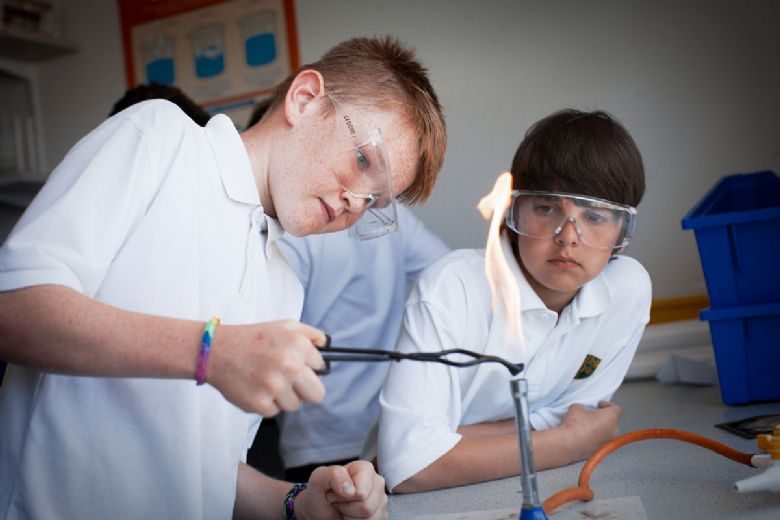
The Science curriculum aims to equip students with the skills and understanding to make sense of the science they meet in everyday life. It considers modern science and future developments.
Through a wide range of activities students will be able to:
- Develop an in-depth understanding of scientific concepts and theories
- Understand the impact of science and technology
- Make informed personal decisions about scientific issues they hear about in the media.
Key Stage 3
Students in Years 7 and 8 follow a Key Stage 3 science course, based on the National Curriculum. This challenging course provides a solid foundation for GCSE science courses by introducing students to a wide variety of concepts in biology, chemistry and physics. It is designed to promote scientific enquiry, stimulate curiosity in the world around them and develop an understanding of how science works. The course will engage students in theory, practical work, written projects and research tasks using a variety of resources, all fully supported by help sheets and extension exercises. Students are assessed and tested regularly to provide a record of their progress across the year and there is a terminal examination towards the end of each year.
Key Stage 4
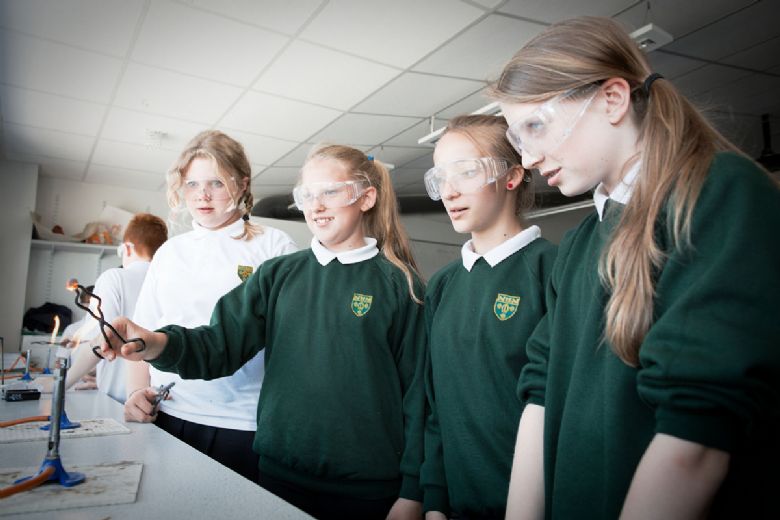
Students begin the GCSE course in Year 9. At the end of Year 9 the students have a choice of pathways through Years 10 and 11. The most common pathway is GCSE Combined Science: Trilogy, which will lead to a double award GCSE qualification. Students with an aptitude for the sciences are encouraged to follow the Single Science course leading to three GCSE qualifications in Biology, Chemistry and Physics. The final grades for all pathways are based on exam results only at the end of the course and as for Key Stage 3, students are assessed and tested regularly to provide a detailed record of their progress.
Post 16
Four courses are currently offered at Post 16.
- A Level Biology A specification code: H420
- A Level Chemistry A specification code: H432
- A Level Physics A specification code: H556
- Level 3 AAQ Extended Certificate in Applied Science
These courses allow students to specialise in their chosen area of study with regular assessments and testing allowing for a detailed record of their progress.
Biology
If students are looking to break into the world of Science, an A Level in Biology is a great start. Choosing Biology prepares students for further study and careers within the Life Sciences or related disciplines. It will help appreciate how society makes decisions about scientific issues and how the Sciences contribute to the success of the economy and society. Students will cover a wide range of topics including the core principles of Biology, genes and genetic engineering and the effects on the environment. Students will learn to differentiate and assimilate detailed information, and to draw logical conclusions from scientific evidence.
The new A Level course is comprised of the following units:
- Module 1 - Development of practical skills.
- Module 2 - Foundations in Biology; covering concepts such as cell structure, biochemistry and cell division.
- Module 3 - Exchange and Transport; covering the lungs and transport systems in animals and plants.
- Module 4 - Biodiversity, evolution and disease.
- Module 5 - Communication, homeostasis and Energy
- Module 6 - Genetics, evolution and ecosystems
At the end of Year 13 there will be three exams
- Paper 1 assesses content from Modules 1, 2, 3 and 5 and is worth 37% of the final A Level Grade
- Paper 2 assesses content from Modules 1, 2, 4 and 6 and is worth 37% of the final A Level Grade
- Paper 3 assesses content from all Modules and is worth 26% of the final A Level Grade
There is also the ‘Practical endorsement in Biology’ which is reported as a Pass or Fail separately to the A Level qualification.
Chemistry
Chemistry is a challenging and stimulating subject. It has played a major role in improving living standards and is one of the most successful industries in the UK. In most cases, Chemistry is an essential subject for Medicine, Dentistry, Veterinary Science and some Biological Sciences. If students enjoy finding out what happens when substances react and why, if they have enquiring mind and enjoy solving problems or if they enjoy practical work and want to improve their skills and accuracy then an AS or A Level in Chemistry could be the answer. From the moment you are born and throughout your life you are surrounded by Chemistry, in the air you breathe, the food you eat and the clothes you wear. How science works is also integrated throughout along with up to date topics.
The A Level course is comprised of the following units:
- Module 1 – Development of practical skills in chemistry
- Module 2 – Foundations in chemistry
- Module 3 – Periodic table and energy
- Module 4 – Core organic chemistry
- Module 5 – Physical chemistry and transition elements
- Module 6 – Organic chemistry and analysis
At the end of Year 13 there will be three exams
- Paper 1 assesses content from Modules 1, 2, 3 and 5 and is worth 37% of the final A Level Grade
- Paper 2 assesses content from Modules 1, 2, 4 and 6 and is worth 37% of the final A Level Grade
- Paper 3 assesses content from all Modules and is worth 26% of the final A Level Grade
There is also the ‘Practical endorsement in Chemistry’ which is reported as a Pass or Fail separately to the A Level qualification.
Physics
If students have an enquiring mind, enjoy a challenge, and like solving problems, then they should consider studying Physics. From the smallest part of the human body to the great clusters of galaxies, Physics helps us understand how our world works. The applications, like the career opportunities, are infinite. The course aims to develop essential knowledge and understanding of the subject, its applications and skills. It aims to show the link between theory and experiment and how Mathematics can be used to explain physical principles.
The A Level course is comprised of the following units:
- Module 1 – Development of practical skills in physics
- Module 2 – Foundations of physice
- Module 3 – Forces and motion
- Module 4 – Electrons, waves and photons
- Module 5 – Newtonian world and astrophysics
- Module 6 – Particles and medical physics
At the end of Year 13 there will be three exams
- Paper 1 assesses content from Modules 1, 2, 3 and 5 and is worth 37% of the final A Level Grade
- Paper 2 assesses content from Modules 1, 2, 4 and 6 and is worth 37% of the final A Level Grade
- Paper 3 assesses content from all Modules and is worth 26% of the final A Level Grade
There is also the ‘Practical endorsement in Physics’ which is reported as a Pass or Fail separately to the A Level qualification.
Year 12 and 13- Applied Science
Students can study the Extended Certificate (equivalent to one A Level).
Students study three exam units:
- Unit 1 – Principles and application of Biology
- Unit 2 – Principles and application of Chemistry
- Unit 3 – Principles and application of Physics
These are each examined by one hour external exams. They aim to provide a solid foundation of knowledge of each science subject, similar to A Level content.
Students also take two coursework units:
- Unit 4 – Practical scientific procedures and techniques
- Unit 5 – Science investigation skills
These allow students to become competent with a range of common laboratory equipment, and they then use these skills to plan and carry out an investigation into a topic of their choice, which they will then evaluate.
Resources
The department enjoys excellent facilities, large airy Science Laboratories and a wealth of equipment and resources.
Extra Curricular/ Enrichment
- Physics at Work Trip
- Science Live lectures
- Key Stage 3 Science and Lego Robotics Club
- Various Science competitions
- A-Level Science Olympiads
